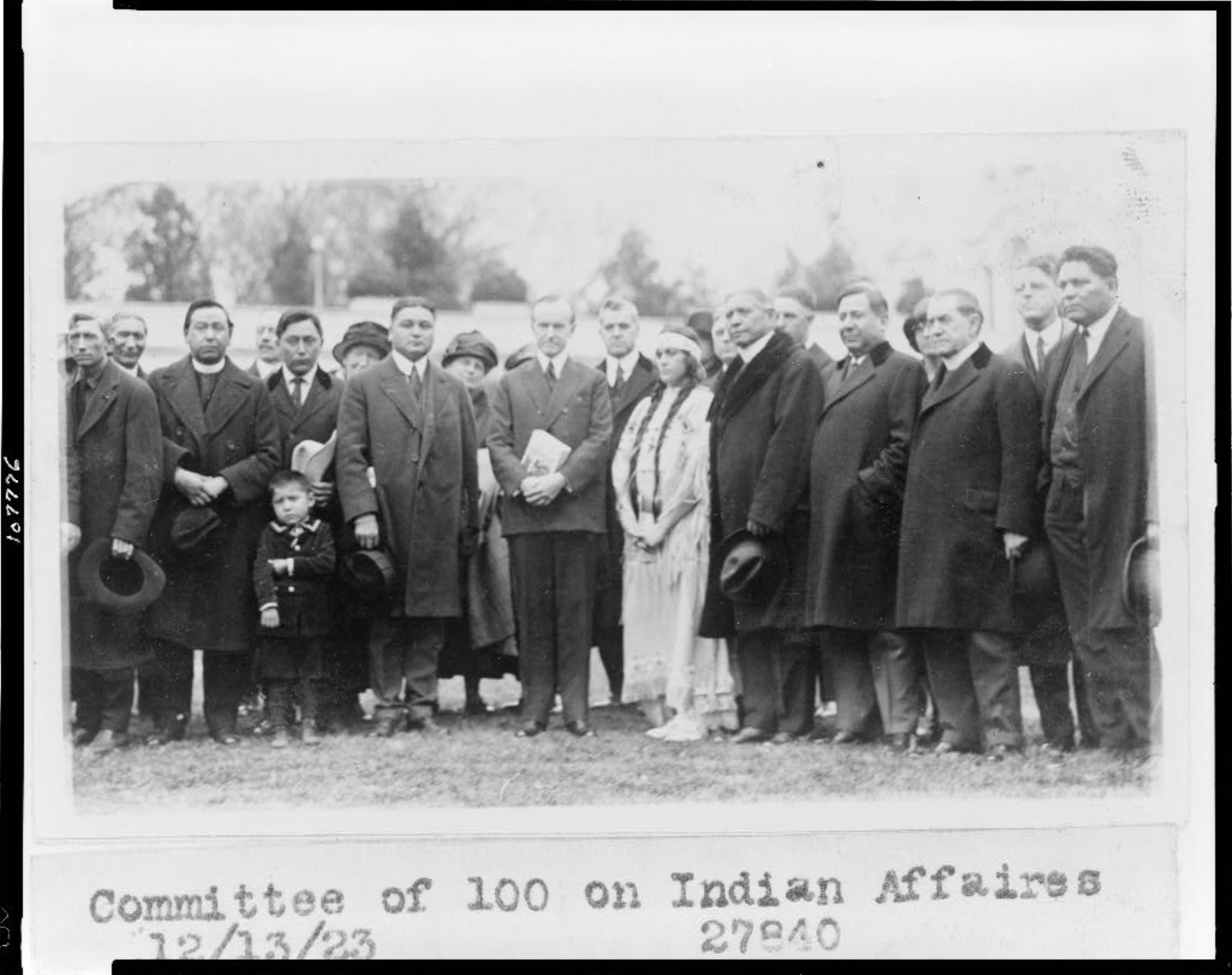
June 2 marked the 100th anniversary of the American Indian Citizenship Act, when all living Native Americans officially became U.S. citizens. Allegedly inspired by the role of Native Americans in World War I and motivated by a claim to Indigenous lineage, President Calvin Coolidge signed the act, also known as the Snyder Act, in 1924, ending a decades-long debate over citizenship for the First Peoples.
The Citizenship Rollout
By 1924, Indigenous populations were beginning to stabilize after centuries of genocide had reduced the tens of millions of people living in North America to just 237,000 within the U.S. at the turn of the 20th century.
But newfound citizenship came with many caveats. Several tribal nations considered accepting U.S. citizenship to be treason, and viewed the Snyder Act as an extension of the assimilation practices being rolled out through boarding schools in both the U.S. and Canada.
Additionally, citizenship did not automatically give voting rights to Indigenous Americans. That responsibility went to statehouses around the country, where many states, including Idaho, neglected to provide voting rights to Native Americans.
Citizenship came to the Gem State’s four reservations about 50 years after their respective establishments in the 1860s and 1870s. Voting rights came another 26 years after the Snyder Act when 73% of Idaho voters approved a 1950 constitutional amendment to allow Indigenous people to vote, serve as jurors, and hold civil office.
Complicated History, Complicated Present
The 15th and 19th Amendments both showed that in America, expanding citizenship or voting rights to a segment of the population does not guarantee equitable or equal access to voting. The same was true for the American Indian Citizenship Act of 1924, as Indigenous people continue to struggle for sovereignty and voting access a century later.
For example, Indigenous people living on reservations or in other rural areas are often deterred from voting by long drives to the polls. And after Native voters have played pivotal roles in recent electoral races in several battleground states, their access to the voting booth has come under direct scrutiny.
The Snyder Act will be a focus of the annual Idaho Indian Education Summit later this summer, held at the College of Western Idaho.
Also worth noting: From June 13 to 16, the 2024 Return of the Boise Valley People will be held at Eagle Rock Park.