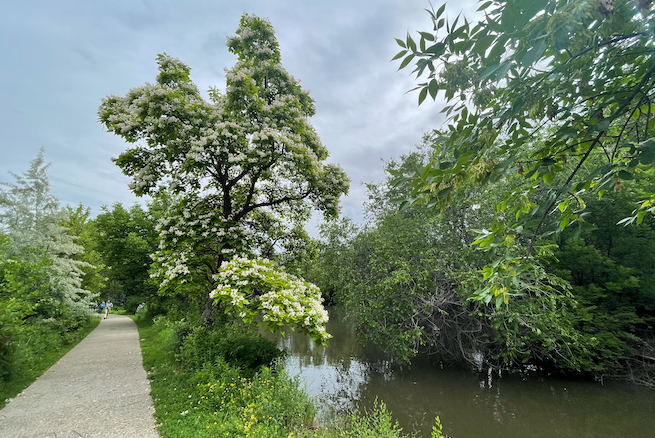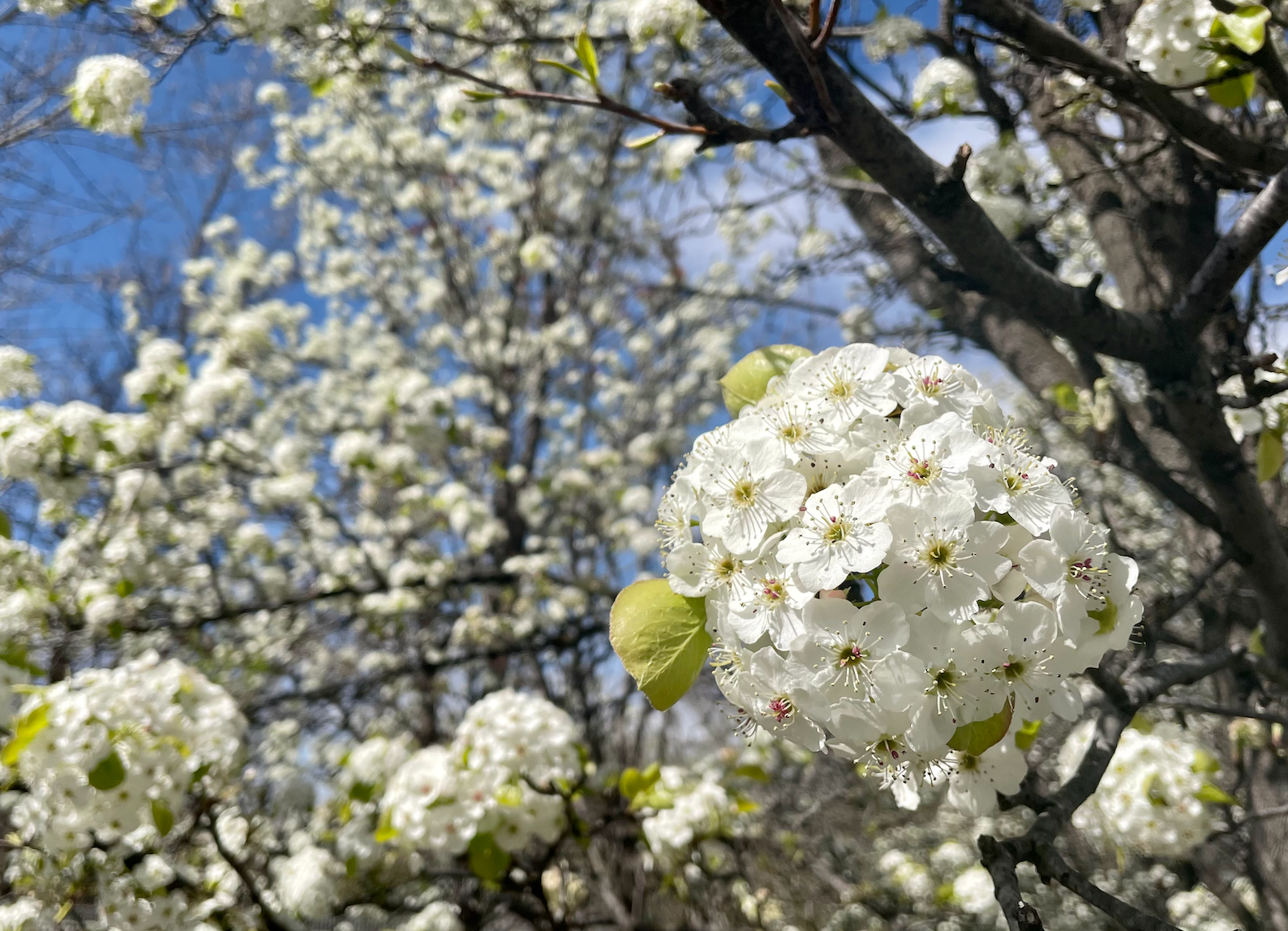
If you’ve had a peaceful bike ride interrupted by a smell like rotting fish recently, you’re not alone. Callery pear trees have beautiful white blossoms and are some of the earliest blooming trees in Boise, but they’re also responsible for filling the air with a pretty horrible stench.
A Tree With History
The Callery pear trees — including one of their descendants, the thornless “Bradford” pear tree — have been here for less than a century. Native to Vietnam and southeastern China, they were brought by missionaries to Europe, and later to the U.S.
They became popular along the East Coast and the Midwest in the mid-20th century, particularly because cities needed fast-growing, resilient trees to line new suburban streets built after World War II.
The benefits were plentiful: for an ornamental tree, Callery pears can grow in many kinds of soil, they grow quickly and vertically, require little pruning, and have blossoms or leaves for a long time.
But the injection of new trees on city streets during the 1950s and 1960s gave Callery pears the green light to unleash their invasive proclivities. Some varieties have thorns large and strong enough to puncture tires, and all can crowd out native plant species.
The Turning Tide
Those factors have turned the Callery pear tree from a developer’s saving grace to a public villain. Every spring, Boiseans come together to decry the tree and vilify the landscapers who still plant them.
We’re nowhere near the public opinion in other states like Ohio, however, where the Callery pear tree is banned and officials and botanists recommend residents replace their trees with native alternatives.
Not only are the trees resilient to physical damage (apart from the fact that their branches are incredibly weak, and their structure dooms them to break in strong winds), but they mutate rapidly. Two trees of the same variety can’t reproduce, but they can with any other type of pear tree, which fuels their ability to take over your lawn or public parks.
So if you have a Callery, cut it low to the ground and use an herbicide on the stump. From there, we can only hope that for the sake of our native plants and our noses that landscapers will stop planting these trees.