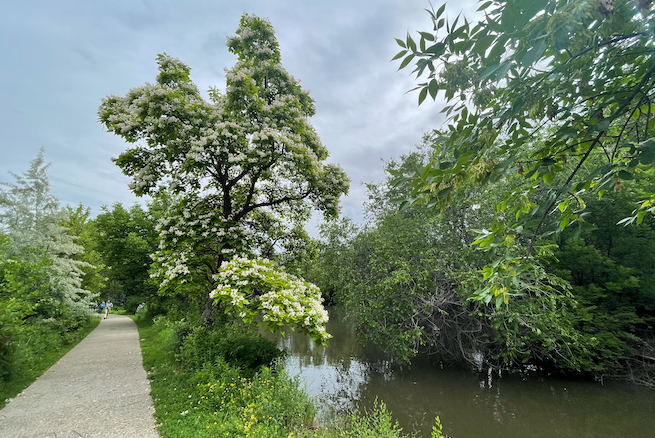
If you have a nature-curious kid (or adult) in your life, take them on a walk through the MK Nature Center and stand with them on the boardwalk over the pond. Sooner or later, you’ll see a creature that evolved before most dinosaurs.
How They Evolved
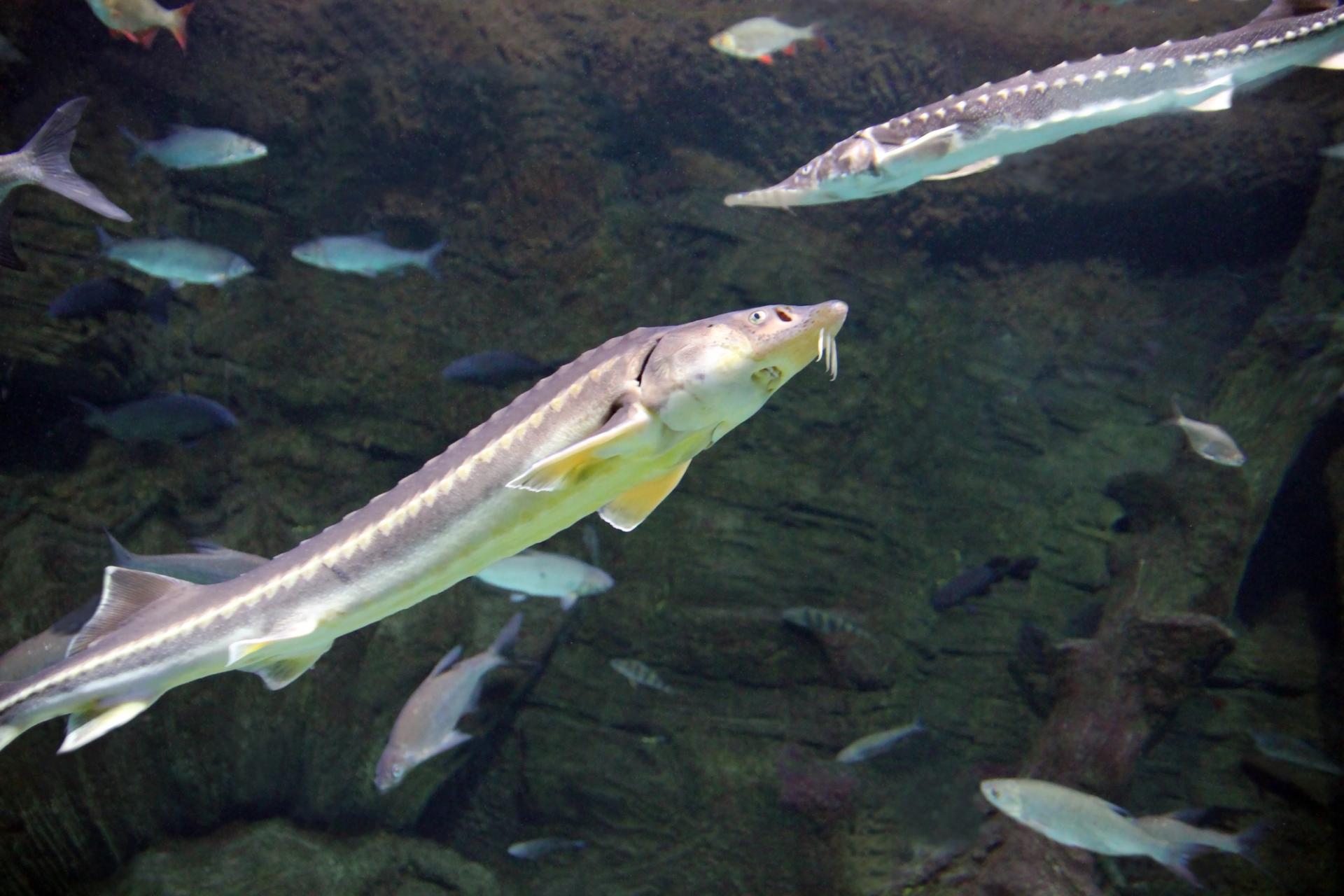
The North American white sturgeon is the continent’s biggest freshwater fish, often clocking in at 5 to 6 feet long as adults, though they’ve been known to reach 20 feet in length and weighing well over 1,000 pounds.
Though they may look like sharks, sturgeon don’t have teeth, or scales. Their mouths face downward to vacuum food off river or lake floors — they’re not exactly scary enough to humans to inspire Spielbergian horror, but their story is still impressive.
After their ancestors survived the Permian extinction about 252 million years ago, sturgeon were left to take over North America’s fresh waters. They evolved into nine different species, including the white sturgeon, which have traveled throughout the Columbia River Basin for millennia.
In southern Idaho, white sturgeon accompanied their better-known anadromous counterparts like sockeye salmon and steelhead trout, traveling thousands of miles from the Pacific Ocean to freshwater rivers and lakes as far inland as Shoshone Falls, near present-day Twin Falls.
Conservation Efforts
While the fish historically had free-range in this part of the world, dams, poaching, and other disruptions to the river ecosystem have left the species dependent on humans for reproduction.
When white settlers discovered sturgeon in the eastern U.S., they considered the large fish pests because they could tear through fishing nets designed for smaller prey. Later, we poached them for caviar, nearly to extinction.
On the Columbia River Basin, which includes the Snake River, dams have affected white sturgeon similarly to their effects on other fish.
A stretch of the Snake River between Bliss and the CJ Strike Reservoir has long boasted the river’s healthiest and most important sturgeon population. Along the Snake River, white sturgeon eggs are harvested and brought to labs, where they are incubated and brought up for a year. Between the Bliss and CJ Strike dams, however, are the only remaining white sturgeon populations that reproduce independently in southern Idaho.
The Idaho Department of Fish and Game developed a plan to preserve white sturgeon in 2008. As recently as 2022, sturgeon fishing (which already only catch-and-release) in the CJ Strike Reservoir was temporarily closed after dozens of white sturgeon were found dead. Their populations took another hit last summer when treatment to kill invasive quagga mussels also killed at least 48 sturgeon — just the latest threat to the massive, prehistoric fish.